Search Artists
 Search Disciplines
 Search
Places
Search
Places
Image
Afbeelding

Role
Advisor for Creative Europe MEDIA
Email
m.ueffing [at] dutchculture.nl


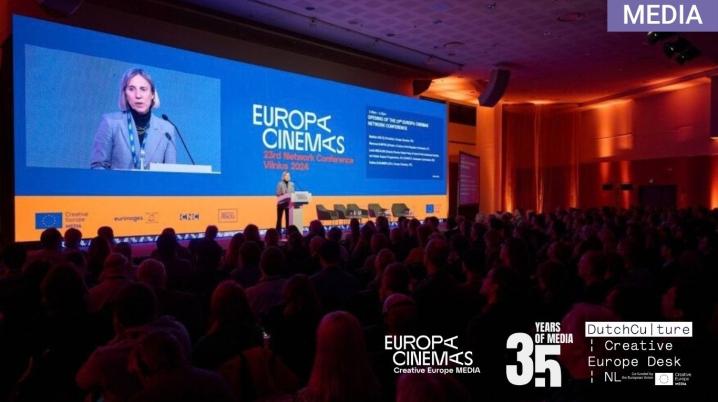
Dit jaar viert het MEDIA-programma van Creative Europe zijn 35-jarig bestaan. Al drieënhalf decennium ondersteunt MEDIA de Europese audiovisuele sector, van de ontwikkeling en distributie van Europese films tot het versterken van internationale samenwerking en het bereiken van nieuwe publieksgroepen.
Ter gelegenheid van dit jubileum sprak Europa Cinemas met Lucia Recalde, Deputy Director & Head of Unit for Audiovisual Industry and Media Support Programmes bij de Europese Commissie. In het interview blikt zij terug op de afgelopen 35 jaar MEDIA en de ontwikkeling van het programma, en gaat zij in op de rol die Europese samenwerking en ondersteuning hebben gespeeld bij het versterken van de audiovisuele sector. Tegelijkertijd staat de sector aan de vooravond van een nieuwe programmaperiode. Met het voorgestelde AgoraEU-programma kijkt de Europese Commissie vooruit naar de periode 2028–2034. In het interview bespreekt Lucia Recalde ook deze nieuwe fase en de ambities voor de Europese culturele en audiovisuele sector.
Wat kunnen we meenemen uit 35 jaar MEDIA en wat staat de sector te wachten? Lees het volledige interview (EN) met Lucia Recalde bij Europa Cinemas en ontdek haar visie op de toekomst van Europese audiovisuele samenwerking.
The MEDIA programme stands as a clear success story for Europe’s audiovisual sector. For more than 30 years, it has helped European films and audiovisual works travel across borders, find new audiences and compete globally. It supports our creators and talent, strengthens Europe’s cultural diversity and proves that investing in audiovisual also means investing in growth, innovation and jobs.
MEDIA has been a driving force behind European co-productions, championing stories with the power to cross borders. By boosting collaboration in development and production, the programme has helped projects reach wider audiences, unlock financing and connect creators who see Europe as a space of shared opportunity. In doing so, it has strengthened the sector’s competitiveness.
One of MEDIA’s most significant achievements has been to boost the cross-border circulation of European works in a market still deeply fragmented along national lines. A prime example is Europa Cinemas, MEDIA’s first and most important flagship initiative, launched in 1992. Today, the network unites nearly 1,300 cinemas and more than 3,000 screens across around 40 countries. Together, they champion non-national European films, giving them a strong presence on screen while nurturing the audiences of tomorrow. Between 2014 and 2023, Europa Cinemas generated almost 40% of all tickets sold for non-national European films in the EU. That is a remarkable achievement; and one that should be built on in the context of the EU’s next multiannual financial framework, as AgoraEU, the successor programme of Creative Europe, will soon begin to take shape.
AgoraEU is not just Creative Europe under a new label. It reflects a clear political choice: to bring culture, media and civic space closer together since they all contribute to an open, pluralistic and resilient public sphere. For cinemas, that matters directly. Through MEDIA+, the EU will continue to back the audiovisual ecosystem, with networks such as Europa Cinemas playing a pivotal role in connecting European films with audiences across borders. But cinemas are more than screens: they are cultural anchors in their communities, promoting Europe’s diversity, nurturing debate and helping citizens engage with different stories, perspectives and realities. In that sense, Europa Cinemas sits at the crossroads of AgoraEU’s three ambitions: strengthening the media and film ecosystem, supporting culture, and promoting the European values that underpin democratic and resilient societies.
Concretely, AgoraEU would bring together Creative Europe, the Citizens, Equality, Rights and Values (CERV) programme and current support to news media under one common framework, while keeping three distinct strands: Creative Europe – Culture, MEDIA+, and CERV+. Each will retain its own logic and priorities, but the new structure is designed to make EU action more coherent, more visible and better able to generate synergies across sectors. For cinemas, MEDIA+ will remain the main gateway for support.
The Commission has proposed an overall budget of €8.6 billion for 2028–2034, including an indicative €3.2 billion for MEDIA+. These are the Commission’s proposed figures; the final amounts will depend on negotiations on the next long-term EU budget.
AgoraEU’s ambitions for cinemas are greater than ever. At the heart of the proposal is a stronger role for Europa Cinemas, building on the collaboration that already exists among cinema operators, expanding the successful Collaborate to Innovate actions, and extending the network’s reach even further.
AgoraEU also wants to place much greater emphasis on audiences who are still too often left behind, particularly people living in underserved areas and so-called “cinema deserts”. In these places, access to film culture is uneven, and audiences are effectively excluded from the shared experience of cinema. This matters because cinema is not simply a leisure activity; it is a space for cultural participation, discovery, and social connection.
Another priority is the expansion of unlimited cinema subscription models, like Cineville, across Europe. These proven audience-development schemes have demonstrated a strong capacity to strengthen access to European films while supporting the sustainability of local cinemas. Importantly, they have also had a significant impact on bringing young audiences back to cinemas, helping to reconnect a new generation with the cinema experience. The recent Cineville Eurotrip experiment provided a compelling illustration of this potential. From 1 July to 31 August 2026, subscribers were able to use their unlimited cinema pass across borders in the Netherlands, Belgium, Germany, Austria and Sweden, covering 92 cities and 248 cinemas. This initiative demonstrated how subscription models can foster cross-border cultural participation and audience mobility, highlighting their strong potential for further development under AgoraEU.
AgoraEU is also looking outward. Through Europa Cinemas, it aims to explore renewed cooperation with selected regions of the world, building on past experience under MEDIA Mundus and on the international links that remain in place.
It may be helpful to briefly recall how the EU legislative process works. The Commission submits a proposal, after which the European Parliament and the Council each adopt their own position and then, they get together to negotiate a common text, leading up to the final adoption of the legal act by Parliament and Council.
The Council agreed a partial general approach in May 2026. In the Parliament, the CULT and LIBE committees are finalising their position, with a committee vote expected in the autumn, followed by a plenary vote.
Council and EP representatives should get together around the turn of the year, with the aim of reaching an agreement in good time for the programme to start on 1 January 2028.